How to Read Your Birth Chart: A Beginner's Step-by-Step Guide
Learn how to read your birth chart in five easy steps: planets, signs, houses and aspects, explained in plain English. Grab the cheat sheets and start!
In this article
- How to Read Your Birth Chart: What You Are Looking At
- Step 1: Start With the Big Three
- Step 2: Meet the Planets (the “What”)
- Step 3: Read the Signs (the “How”)
- Step 4: Find the Houses (the “Where”)
- Step 5: Spot the Aspects (How Planets Interact)
- Your 20-Minute Reading Order
- If Your Chart Still Looks Confusing
- Your Next Step
You open your birth chart and see a wheel packed with tiny symbols, colored lines and numbers. It looks like a cockpit, and it is tempting to close the tab. The good news is that you can read your birth chart in layers, one idea at a time, and the whole system boils down to four building blocks. This guide walks you through them in five steps and ends with cheat sheets you can screenshot.
One honest note first: astrology is a cultural tradition, not a science, and there is no scientific evidence that it predicts events. We will use it the way many people do, as a structured set of prompts for self-reflection.
Key takeaways
- A birth chart (natal chart) maps where the Sun, Moon and planets appeared in the sky at your birth, as seen from your birthplace.
- Every reading combines four pieces: a planet (the “what”), a sign (the “how”), a house (the “where”) and aspects (how planets “talk” to each other).
- Read in this order: big three, personal planets, houses, aspects, then the slow outer planets.
- Say each placement in one sentence: “[Planet] in [sign] in [house]”.
- Houses and the rising sign need your exact birth time.
How to Read Your Birth Chart: What You Are Looking At
A birth chart is a snapshot. Real astronomy supplies the data: where the Sun, Moon and planets sat along the zodiac, as seen from your birthplace at your birth moment. Astrologers then interpret that snapshot using symbolism that goes back thousands of years.
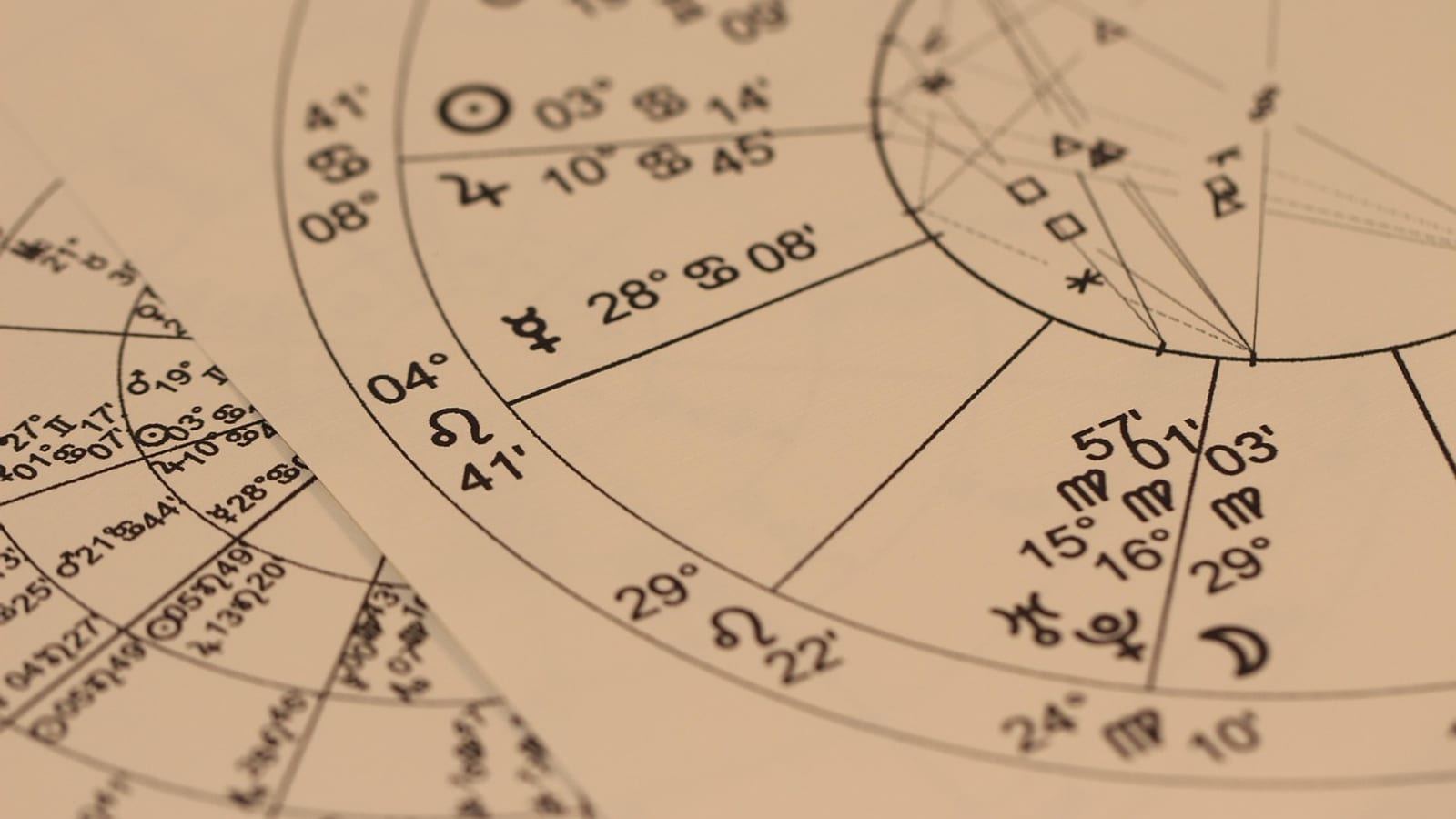
To get one, enter your birth date, exact time and city into a free chart calculator. (Our guide to the sun, moon and rising sign covers that step.) You will see a circle with three layers:
- The outer ring shows the 12 zodiac signs, each covering 30 degrees (12 x 30 = 360).
- The inner wheel is divided into 12 houses, which represent areas of life.
- Symbols and lines show the planets sitting in signs and houses, with lines (aspects) connecting some of them.
Skip the symbols
Most calculators print a plain-text table under the wheel with each planet’s name, sign, degree and house. Read that table instead of decoding tiny glyphs. You can match the names to the wheel later.
Step 1: Start With the Big Three
Before anything else, find your Sun, Moon and Ascendant (rising sign). They give you a three-line summary of the whole chart and make everything after this easier to remember. If you have not pinned yours down yet, the big three guide takes about five minutes.

Write them like this: “Sun in ___, Moon in ___, Ascendant in ___.” Keep that line handy, because the Ascendant also marks the left-hand point of the wheel, where the 1st house begins. You will need that in Step 4.
Step 2: Meet the Planets (the “What”)
Planets are the actors in your chart. In astrology’s symbolism, each one stands for a different part of psychology and daily life. Learn one keyword per planet and the cast list stops looking intimidating.
| Planet | What astrologers say it is about | Keyword |
|---|---|---|
| Sun | Core identity and purpose | Identity |
| Moon | Emotions, comfort and habits | Feelings |
| Mercury | Thinking, learning and communicating | Mind |
| Venus | Values, taste and affection | Values |
| Mars | Drive, energy and how you go after goals | Action |
| Jupiter | Growth, optimism and big-picture thinking | Expansion |
| Saturn | Structure, responsibility and patience | Discipline |
| Uranus | Change, originality and independence | Innovation |
| Neptune | Imagination, intuition and ideals | Dreams |
| Pluto | Transformation, depth and intensity | Depth |
Astrologers call the Sun through Mars the personal planets, because they move quickly and differ a lot from person to person. The slower outer planets are shared by everyone born around the same years: Pluto, for example, stays in one sign for roughly 12 to 31 years. That is why beginners focus on the personal planets first.
Did you know?
Astrologers call the Sun and Moon “planets” as shorthand, but in astronomy the Sun is a star and the Moon is a moon. Pluto was reclassified as a dwarf planet by the International Astronomical Union in 2006. Astrology still includes it, since it works with symbolic meaning rather than astronomical categories. NASA lists the eight official planets if you want the astronomy side.
Your chart may mark a planet with an R or Rx. That means retrograde: from Earth, the planet appeared to move backward against the stars when you were born.
Retrograde is an optical illusion
No planet actually reverses direction. A retrograde planet only appears to move backward because Earth and the planet travel at different speeds on different orbits, like a faster car passing a slower one on the highway. Mercury does this about three to four times a year, each time for around three weeks. Our Mercury retrograde explainer has the full story.
Step 3: Read the Signs (the “How”)
If a planet is the actor, the sign is the costume and the style of acting. Mercury in Gemini and Mercury in Capricorn are the same actor with very different approaches: quick, curious and chatty versus methodical and plan-ahead. Find each planet’s sign in your table, then finish this sentence: “My [planet] works in a [sign] way.”
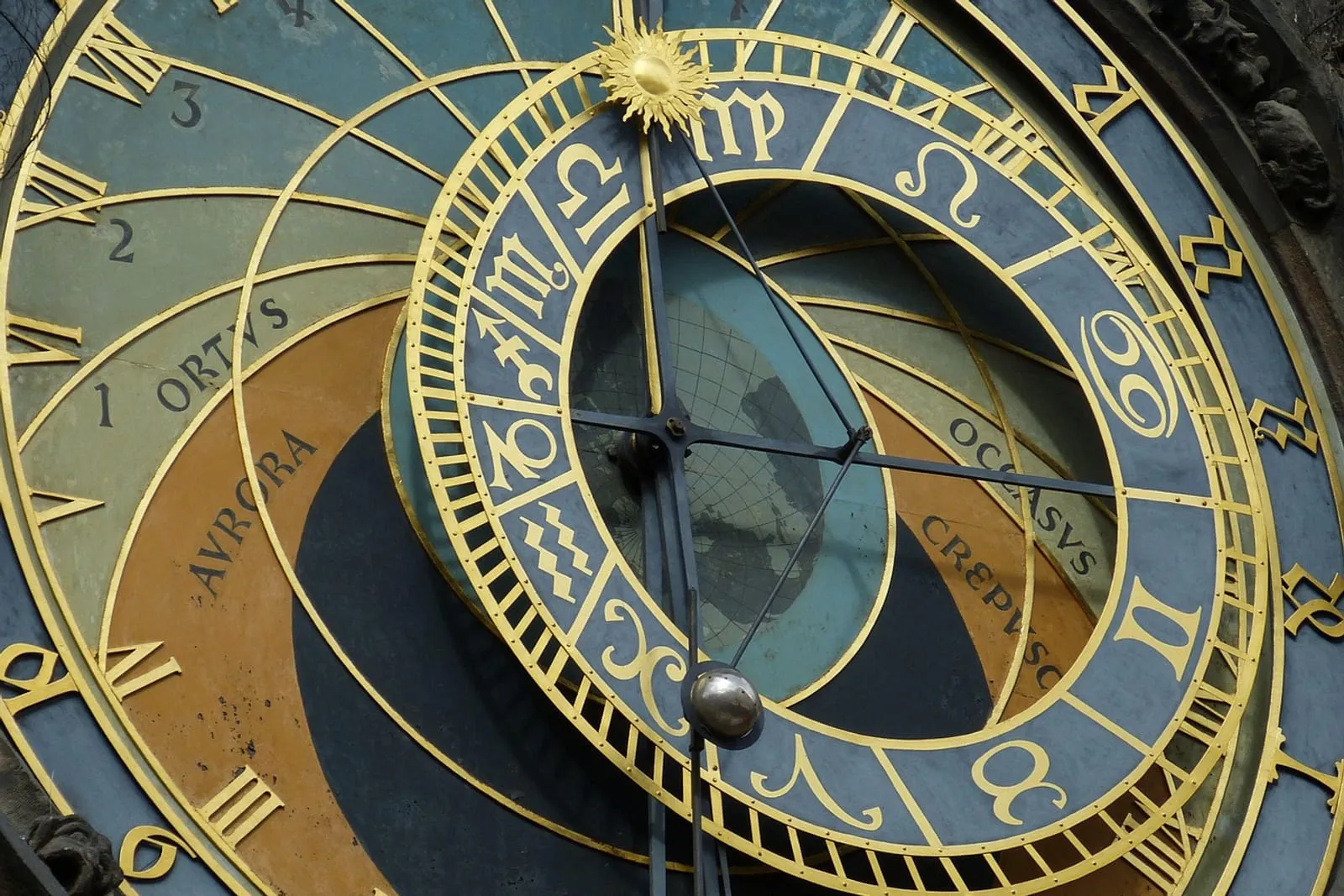
The four elements give you a quick shortcut. Every sign belongs to one, and each comes with a strength and a growth area.
| Element | Signs | Often described as | Common growth area |
|---|---|---|---|
| Fire | Aries, Leo, Sagittarius | Energetic, enthusiastic, courageous | Patience and listening |
| Earth | Taurus, Virgo, Capricorn | Practical, steady, reliable | Flexibility and rest |
| Air | Gemini, Libra, Aquarius | Curious, social, idea-driven | Follow-through and slowing down |
| Water | Cancer, Scorpio, Pisces | Intuitive, caring, emotionally attuned | Boundaries and perspective |
For the full 12-sign grid, see our guide to zodiac elements and modalities. Treat these as starting hints. Each sign adds its own flavor on top of its element, and the degree number next to a planet (such as 12 degrees of Virgo) only tells you how far into the sign it sits.
Step 4: Find the Houses (the “Where”)
Houses show where in life a planet’s theme tends to appear, according to astrologers. The chart has 12 houses. House 1 starts at the Ascendant, on the left side of the wheel around the 9 o’clock position, and the numbering runs counterclockwise from there.

| Houses | Life area | Quick keywords |
|---|---|---|
| 1 to 3 | You and your surroundings | Self (1), money and values (2), communication and learning (3) |
| 4 to 6 | Home and daily life | Roots (4), creativity and play (5), routines and work habits (6) |
| 7 to 9 | Other people and wider horizons | Partnerships (7), shared resources (8), travel and beliefs (9) |
| 10 to 12 | Public and inner life | Career and reputation (10), friends and goals (11), rest and solitude (12) |
Did you know?
There is more than one way to divide a chart into houses. Whole sign houses date back to Hellenistic astrology roughly 2,000 years ago, while Placidus, named after a 17th-century Italian monk and mathematician, is a common default in modern software. The same planet can land in a different house depending on the system.
Because the system changes the result, treat houses as a general theme rather than an exact label.
Houses need an accurate birth time
If you are unsure of your birth time, skip this step and work with planets in signs and aspects instead. A time that is off by an hour or two can move planets into different houses.
Step 5: Spot the Aspects (How Planets Interact)
Aspects are angles between two planets, measured in degrees around the wheel. In astrology, certain angles are said to link planets in meaningful ways. Your calculator draws them as lines or lists them in a grid, so you never have to do the math. These five are the ones to learn first.
| Aspect | Angle | Plain-English meaning |
|---|---|---|
| Conjunction | 0 degrees | Two planets blend and act like one voice |
| Sextile | 60 degrees | Easy cooperation, a gentle opening |
| Square | 90 degrees | Friction that pushes you to act or adjust |
| Trine | 120 degrees | Natural flow, a knack that comes easily |
| Opposition | 180 degrees | A tug-of-war that asks for balance |
Astrologers allow a few degrees of wiggle room, called an orb, so a trine might really measure 118 degrees. And do not sort aspects into good and bad: smooth flow can make us coast, while friction can build skill.
Beat the spiderweb
A chart with every aspect drawn in can look like a tangled web. On your first pass, only look at aspects that touch your Sun, Moon or Ascendant. Ignore the rest until those feel familiar.
Your 20-Minute Reading Order
Now put the layers together. Work through the chart in this order, spending a few minutes on each stop:
- Big three (2 minutes). Sun, Moon and Ascendant signs.
- Mercury, Venus and Mars (5 minutes). Note each sign and the keyword for its planet.
- Houses (5 minutes). Find the house for each of those planets, plus your Sun and Moon.
- Aspects (5 minutes). Look only at aspects to your Sun, Moon and Ascendant.
- Outer planets (3 minutes). Glance at Jupiter through Pluto last, since they are shared by everyone your age.

Here is a worked example with made-up placements. Say your table shows Mercury in Virgo in the 3rd house, sextile Jupiter. Your one-sentence reading might be: “A careful, detail-minded thinking style that shows up in learning and everyday conversation, supported by an optimistic streak. Growth area: not overthinking it.” Planet, sign, house, aspect, one sentence.
The sticky-note habit
Write one placement a day on a sticky note using the formula “[Planet] in [sign] in [house] means ___.” In two weeks you will have a dozen readings in your own words, which beats memorizing a glossary.
If Your Chart Still Looks Confusing
- There are too many symbols. Use the text table under the wheel and ignore the drawing for now.
- Two calculators give different houses. They are probably using different house systems or slightly different birth times. Pick one system and stay with it.
- Your Sun sign is different on another site. Some sites use the sidereal zodiac of Vedic astrology, which sits about 24 degrees behind the tropical zodiac used in most Western astrology.
- Your placements seem to contradict each other. That is normal. Most charts mix outgoing and quiet, practical and dreamy. Astrologers read that mix as nuance, not as an error.
- You do not know your birth time. Read planets in signs and aspects, and skip the Ascendant and houses.
Your Next Step
Pick one placement from your chart today and write a single sentence about it. Then check whether any part feels true, and let go of anything that does not. Journaling it as part of an evening routine or alongside morning routine ideas keeps the habit easy.
If you have not looked up your big three yet, start with the sun moon and rising sign guide. Everything in this guide builds on those three lines.
Frequently Asked Questions
What do I need to read my birth chart?
What is the easiest way to start reading a birth chart?
What do the houses mean in a birth chart?
What is an aspect in a birth chart?
You might also like
More in Astrology →
Venus Sign Explained: What It Says About How You Love
Your Venus sign is said to show how you give and receive affection. Find yours, see all 12 love styles in one table and try a reflection prompt tonight.

Sun Moon and Rising Sign: Your Big Three in Plain English
Your sun moon and rising sign explained in plain English: what each one means, how they differ and how to find yours. Includes a reflection table. Start here!
Birthstones by Month: Colors, Meanings and Zodiac Matches
Birthstones by month in one easy chart: stones, colors, folklore and zodiac matches for all 12 months, plus gift tips and care advice. Find yours!