Birthstones by Month: Colors, Meanings and Zodiac Matches
Birthstones by month in one easy chart: stones, colors, folklore and zodiac matches for all 12 months, plus gift tips and care advice. Find yours!
In this article
Shopping for a birthday gift and wondering what their birthstone is? Or curious why June seems to have three stones while April has only one? This guide covers birthstones by month for the whole year: the stone, its color, the folklore behind it and the zodiac signs that overlap each month. You will also find tips for choosing jewelry and a simple care plan so your stone stays beautiful.
Key takeaways
- The modern US birthstone list was first published in 1912 and has been updated since, so some months have two or three stones.
- Every stone below is a correct choice for its month. Pick your favorite color.
- Birthstone meanings are folklore. There is no scientific evidence that gemstones influence luck, health or personality.
- Each zodiac sign spans two calendar months, so each sign has two sets of birthstone options.
- Hard stones suit daily rings. Soft stones (pearl, opal, turquoise) are best in earrings and pendants.
Birthstones by Month: The Full Chart
In 1912, a US jewelry trade association (now Jewelers of America) published an official list of birthstones. Later updates added stones such as tanzanite in 2002 and spinel in 2016. The table below shows the modern list used by most US jewelers, with colors as they usually appear.
| Month | Birthstone | Typical colors |
|---|---|---|
| January | Garnet | Deep red (also orange, green, pink) |
| February | Amethyst | Light lilac to deep purple |
| March | Aquamarine | Pale blue to blue-green |
| April | Diamond | Colorless (also yellow, pink, blue) |
| May | Emerald | Green |
| June | Pearl, moonstone, alexandrite | Cream or white; white with a blue glow; green to red |
| July | Ruby | Red |
| August | Peridot, spinel | Yellow-green; red, pink, blue, purple |
| September | Sapphire | Blue (also pink, yellow, green) |
| October | Opal, tourmaline | White with rainbow flashes; almost every color |
| November | Topaz, citrine | Colorless, blue, orange; yellow to orange-brown |
| December | Turquoise, tanzanite, zircon | Blue-green; blue-violet; blue or colorless |
Lists differ slightly between organizations and sellers. Older “traditional” lists name bloodstone for March and sardonyx for August, and you may see a few other stones on jewelry-store charts. For a second reference, see the GIA birthstone guide.
Birthstone Meanings and Folklore, Month by Month
Birthstone “meanings” come from centuries of stories, trade customs and marketing. They are fun to read and make a thoughtful card message, but they are tradition rather than science.
- January, garnet. The name is linked to the Latin word for pomegranate, because small red crystals look like the fruit’s seeds. Folklore often ties garnet to protection for travelers.
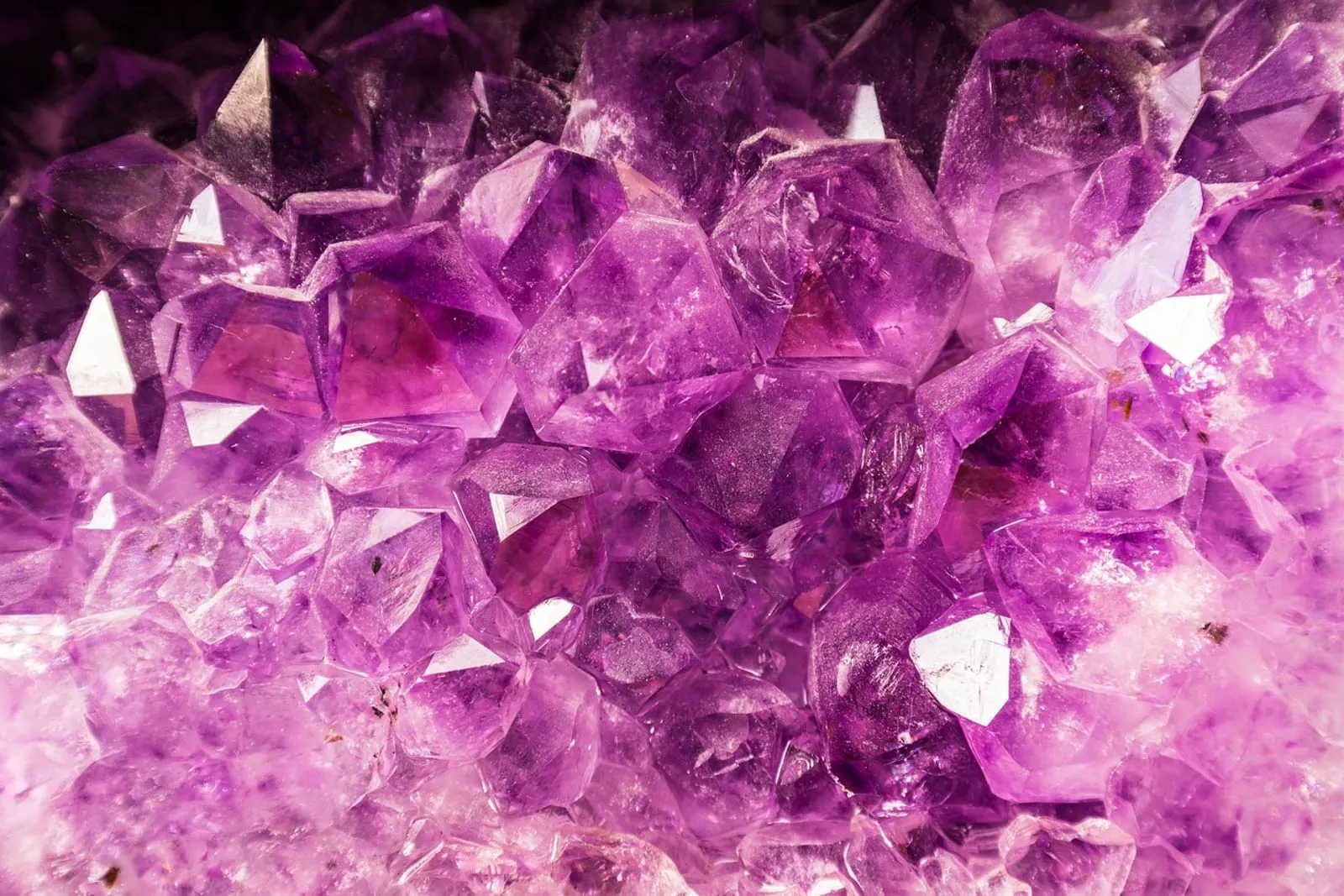
- February, amethyst. Its name comes from a Greek word meaning “not intoxicated,” because ancient Greeks believed it guarded against drunkenness.
- March, aquamarine. The name means “water of the sea” in Latin, and stories say sailors carried it for safe voyages.
- April, diamond. The word comes from the Greek adamas, meaning “unconquerable.” Diamond is the hardest natural gem (10 on the Mohs scale).
- May, emerald. In many traditions green emerald stands for spring and renewal.
- June, pearl, moonstone, alexandrite. Pearls form inside living oysters and mussels. Roman and Greek stories linked moonstone with lunar deities. Alexandrite was found in Russia’s Ural Mountains in 1830 and named for the young future Tsar Alexander II.
Did you know?
Alexandrite looks green to bluish green in daylight and red to purplish red under incandescent light. Gemologists call this rare effect a color change, and it is why alexandrite is one of the most talked-about June stones.
- July, ruby. Red has long meant passion and vitality in stories about this stone.
- August, peridot and spinel. Some historians speculate that Cleopatra’s famous “emeralds” were really peridot. For centuries spinel was mistaken for ruby, and the famous Black Prince’s Ruby is a spinel.
- September, sapphire. Blue sapphire is linked in tradition with wisdom and loyalty.
- October, opal and tourmaline. Opal’s shifting rainbow flashes inspired legends in many cultures. Tourmaline’s name comes from a Sinhalese word meaning “stone with mixed colors.”
- November, topaz and citrine. Both are sunny stones. Most citrine on the market is heat-treated amethyst.
- December, turquoise, tanzanite, zircon. Turquoise decorates King Tut’s funeral mask. Tanzanite was found in Tanzania in 1967 and promoted by Tiffany & Co. starting in 1968. In the Middle Ages, zircon was thought to bring deep sleep and ward off evil spirits.
Folklore, not science
Astrology and crystal lore are cultural traditions. There is no scientific evidence that wearing a birthstone changes your luck, mood, health, love life or finances. Enjoy these stories for the beauty and history in them.
Zodiac Matches: Which Birthstones Fit Your Sign?
Zodiac signs start around the 20th to 23rd of one month and run to about the 19th to 22nd of the next. That means each sign overlaps two birthstone months. In astrology people also pair signs with “zodiac stones,” but those lists vary widely by source, so this table sticks to the simple overlap. Not sure of your sign? Check the zodiac signs dates and traits chart.
| Sign | Dates | Birthstones from the overlapping months |
|---|---|---|
| Aries | Mar 21–Apr 19 | Aquamarine, diamond |
| Taurus | Apr 20–May 20 | Diamond, emerald |
| Gemini | May 21–Jun 20 | Emerald, pearl, moonstone, alexandrite |
| Cancer | Jun 21–Jul 22 | Pearl, moonstone, alexandrite, ruby |
| Leo | Jul 23–Aug 22 | Ruby, peridot, spinel |
| Virgo | Aug 23–Sep 22 | Peridot, spinel, sapphire |
| Libra | Sep 23–Oct 22 | Sapphire, opal, tourmaline |
| Scorpio | Oct 23–Nov 21 | Opal, tourmaline, topaz, citrine |
| Sagittarius | Nov 22–Dec 21 | Topaz, citrine, turquoise, tanzanite, zircon |
| Capricorn | Dec 22–Jan 19 | Turquoise, tanzanite, zircon, garnet |
| Aquarius | Jan 20–Feb 18 | Garnet, amethyst |
| Pisces | Feb 19–Mar 20 | Amethyst, aquamarine |
Say you were born on July 30. Your birth month stone is ruby, and as a Leo you could also choose August’s peridot or spinel. Wear the one whose color you like best. Want a gift to go with it? Pair the stone with one of these zodiac self-care ideas.
How to Choose Birthstone Jewelry or a Gift
Pick the setting first, then the stone. A stone’s hardness and how the piece will be worn matter more than the month.
| If the person… | Choose… |
|---|---|
| Wears the same ring every day | Sapphire, ruby, diamond, spinel or alexandrite |
| Prefers necklaces or earrings | Any stone, including pearl, opal or turquoise |
| Loves bold color | Garnet, tourmaline, peridot or tanzanite |
| Likes a soft, classic look | Pearl, moonstone or aquamarine |
| Has a month with several stones | Pick the color they wear most often |
Quick hack
Do not know a ring size? Choose a pendant, studs or a bracelet. Or borrow a ring they already wear on the same finger and compare it to a printable ring-size chart or ask a jeweler to measure it.
Before you buy, ask whether the stone is natural, treated or lab-grown, and get that in writing. Treatments like heating are common and accepted for many stones, but you should know what you are paying for. A few examples: most blue topaz is colorless topaz treated with irradiation and heat, and most citrine is heat-treated amethyst.
Hardness and Care: Keep Your Stone Beautiful
The Mohs scale measures how easily a stone scratches, from 1 (soft) to 10 (diamond). It does not measure toughness, so some hard stones can still chip, such as topaz.
| Stone | Mohs hardness | Everyday ring? |
|---|---|---|
| Diamond | 10 | Yes |
| Ruby, sapphire | 9 | Yes |
| Alexandrite | 8.5 | Yes |
| Spinel, topaz | 8 | Spinel yes; topaz with care |
| Emerald, aquamarine | 7.5–8 | With care |
| Amethyst, citrine | 7 | With care |
| Tourmaline | 7–7.5 | Yes, with care |
| Garnet | 6.5–7.5 | With care |
| Peridot | 6.5–7 | Better in earrings or pendants |
| Tanzanite, zircon | 6–7.5 | Better in earrings or pendants |
| Moonstone | 6–6.5 | Better in earrings or pendants |
| Opal | 5–6.5 | Better in earrings or pendants |
| Turquoise | 5–6 | Better in earrings or pendants |
| Pearl | 2.5–4.5 | Better in earrings or pendants |
General care rules for any gemstone:
- Put jewelry on last. Perfume, hairspray and lotion can dull stones and pearls.
- Take it off for swimming, cleaning, workouts and sleep.
- Clean gently. Use warm water, a drop of mild dish soap and a soft brush for hard stones, then rinse and pat dry. For pearls, opals, turquoise and moonstone, wipe with a soft damp cloth and skip ultrasonic and steam cleaners.
- Store pieces separately in soft pouches so harder stones cannot scratch softer ones.
- Visit a jeweler once a year to check prongs and clasps.
Quick hack
Keep a small cloth pouch or an empty egg carton in your jewelry drawer. Each piece gets its own pocket, so nothing tangles or scratches.
Birthstone Myths vs Facts
| Myth | Fact |
|---|---|
| There is one official list worldwide | Lists differ by country and organization, and the US list has changed since 1912 |
| You must wear your exact birth month stone | Any stone you love is fine; the list is a tradition |
| Zircon is the same as cubic zirconia | Zircon is a natural mineral; cubic zirconia is lab-made |
| Ruby and sapphire are different minerals | Both are corundum: red corundum is ruby, other colors are sapphire |
| Blue topaz is always natural | Most blue topaz is treated colorless topaz |
If You Are Stuck
| Problem | Try this |
|---|---|
| Your month has three stones and you cannot decide | Choose by color, then by how often you will wear it |
| The stone you love is soft | Pick a pendant or earrings, or a ring with a protective setting for special days |
| The budget feels tight | Choose a smaller stone or a lab-grown one, clearly labeled |
| A stone looks cloudy | Clean it gently, then ask a jeweler to look at it |
| You are buying for a big milestone | Ask the seller about a gem lab report |
Your Next Step
Find your month in the chart, pick the stone whose color you love most and write it in your phone notes. For a birthday ritual that goes with it, spend five minutes with the prompts in our journaling for beginners guide, and write a letter to the person you will be next year.
Frequently Asked Questions
What are the birthstones by month?
Why do some months have more than one birthstone?
Do birthstones really have powers?
Which birthstones are best for everyday rings?
You might also like
More in Astrology →
Self-Care for Each Zodiac Sign: 12 Easy Ideas
Self-care for each zodiac sign: one easy, everyday idea per sign, from walks to tidying and creative time, plus an element table. Find yours today!

Sun Moon and Rising Sign: Your Big Three in Plain English
Your sun moon and rising sign explained in plain English: what each one means, how they differ and how to find yours. Includes a reflection table. Start here!

Zodiac Elements and Modalities: Fire, Earth, Air, Water Explained
Learn how zodiac elements and modalities work: fire, earth, air and water, plus cardinal, fixed and mutable. See the 12-sign grid and reflect on yours!